
Cybersecurity can feel abstract until you hear what a real incident looks like from the inside, how it spreads, how it breaks systems, and what it costs when the world’s infrastructure suddenly has to fall back to pen and paper.
That’s exactly what IronCircle’s Cyber Briefings are built to deliver: an inside look into the cybersecurity industry through candid conversations with professionals who’ve lived it.
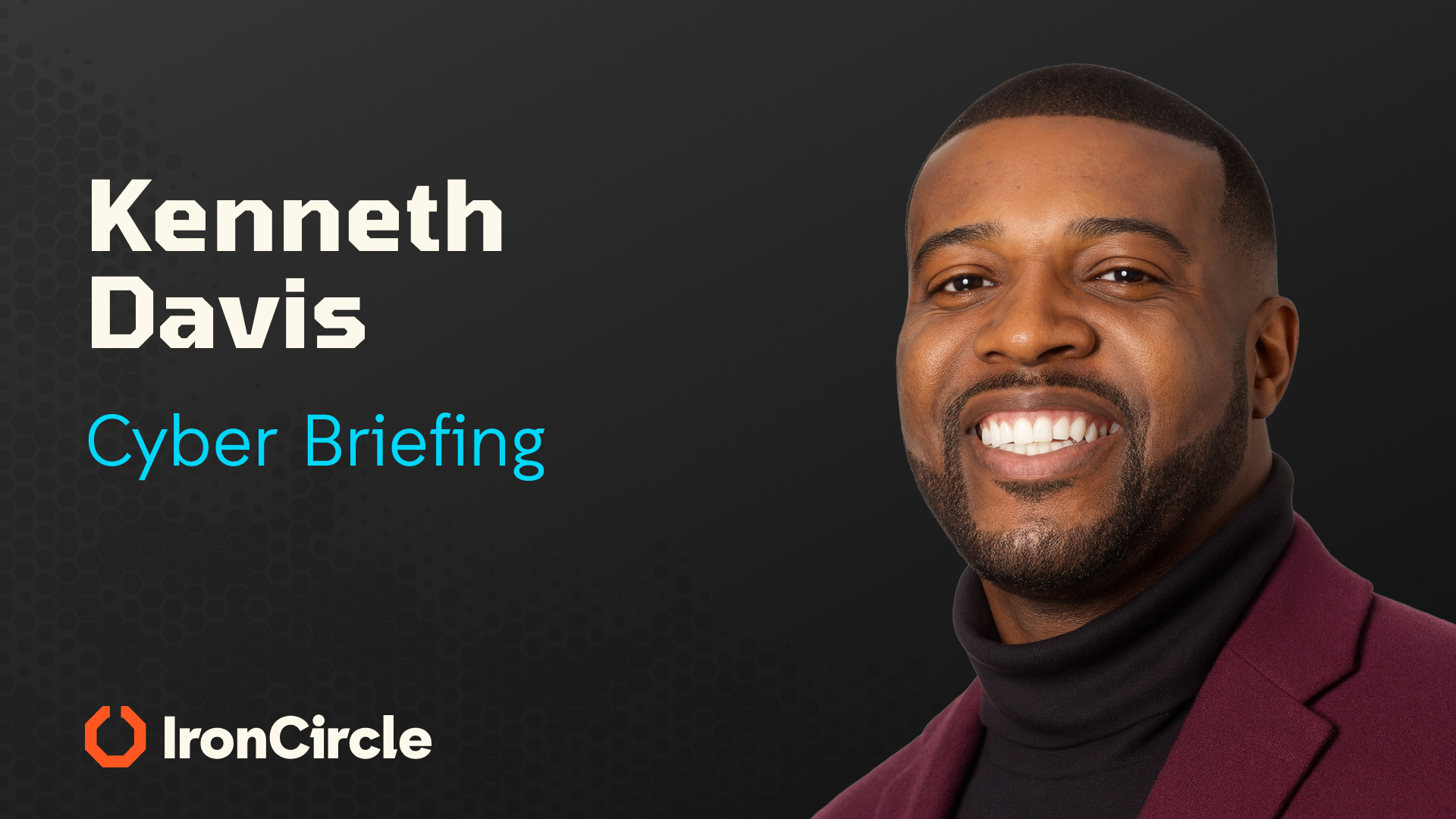
In this session, IronCircle’s VP of Product Mike Passaro sits down with Kenneth Davis, an IronCircle graduate whose career path took him from IT roles to incident response during a major disruption, then into red teaming and penetration testing with the Department of Homeland Security, and now to an Information System Security Officer role at Boeing.
Kenneth Davis on the NotPetya Attack, Hard Lessons in Cybersecurity, and What it Really Takes to Succeed in Cybersecurity
In June 2017, Maersk, one of the largest shipping and logistics companies on the planet, was hit by what many initially called a ransomware attack. But as Davis explains, NotPetya wasn’t about money. It was about destruction.
At the time, Davis was working at the Port of Long Beach. Almost overnight, a multi-billion-dollar operation responsible for moving thousands of containers each week ground to a halt. Ships arrived, containers piled up, and no one could see what was where.
The most shocking part? A basic security failure.
Maersk lacked proper network segmentation, an entry-level control taught early in IT and cybersecurity training. One infected system was able to move laterally, gain privileges, and spread across the entire enterprise. The attack began in Ukraine and rippled across the globe, eventually shutting down operations in California.
One weak door was all it took.
When IT Fails, Operations Collapse
The damage went far beyond computers.
Without functional systems, port operations reverted to pen and paper. Containers were manually logged as they came off ships. Clerks physically checked off thousands of units per shift. The modern shipping terminal was suddenly operating like it was decades in the past.
This was Davis’s crash course in Operational Technology (OT) risk.
His role quickly shifted from IT automation to full incident response, rebuilding network configurations, reimaging systems, and restoring what could be salvaged. The lesson stuck: security can’t be bolted on later. If it’s not built in from the start, the cost of failure is enormous.
The Skills That Helped David Advance His Cybersecurity Career
David’s career leap, from resetting passwords to protecting classified systems, wasn’t luck. It was built on fundamentals. For beginners, David recommends mastering two skills:
- Networking fundamentals – You must understand how the internet actually works—IP addresses, subnetting, packet flow, and the OSI model. Know what happens when you send an email or type a URL into a browser. Without this foundation, security concepts never fully click.
- Hands-On Linux – Get comfortable in the terminal. Force yourself to use the command line for daily tasks. Servers, networking gear, scripting, and automation all live there. If you avoid it, you’re limiting your career before it starts.
For experienced professionals, David says one skills separates the great from the good: communication. Being able to explain technical risk to non-technical decision-makers, managers, executives, CEOs, is critical. They don’t think in packets and exploits. They think about cost, impact, and risk. If you can explain a complex issue simply, you truly understand it.
The Real Threat of AI
Looking forward, his biggest concern isn’t AI hype, it’s scale.
AI allows attackers to automate, adapt, and launch attacks across multiple networks simultaneously. Scripts can be written, tested, modified, and redeployed faster than ever. Shrinking security teams in response to this reality, he warns, is a dangerous mistake.
In highly classified environments, human oversight still dominates due to compliance and contract requirements. But the speed at which AI is evolving, without fully understanding long-term consequences, is deeply concerning.
From the Port of Long Beach to Boeing: What Real Cybersecurity Training Looks Like
Ken’s journey, from working in IT roles at the Port of Long Beach, to responding to one of the most disruptive cyber incidents in global shipping, to red teaming with the Department of Homeland Security and now defending classified systems at Boeing, shows what real cybersecurity work actually looks like. It’s not theoretical. It’s operational. It’s high-stakes. And it demands professionals who know how to perform under pressure.
That’s exactly what IronCircle is built to deliver. Through hands-on labs, real-world scenarios, and immersive training, learners build the same skills Ken used to rebuild networks, hunt vulnerabilities, and protect critical infrastructure. Cyber Briefings empower learners with an inside look at the realities of the field before they ever step into their first role. Together, they offer more than training, they offer a clear path into a real cybersecurity career.
From watching a global shipping giant collapse due to basic security failures to defending some of the most sensitive systems in the country, Davis’s journey shows what’s possible when preparation meets opportunity.